
This month
May and early June have been a period of deadlines landing and data improving. Two significant consultations have now closed, the BSR’s latest Gateway 2 figures are the most encouraging yet, and the Grenfell Inquiry progress report signals that professional competence reform is moving from consultation into delivery. For organisations communicating with residents and communities about building safety, each of these developments has a practical dimension worth thinking about now.
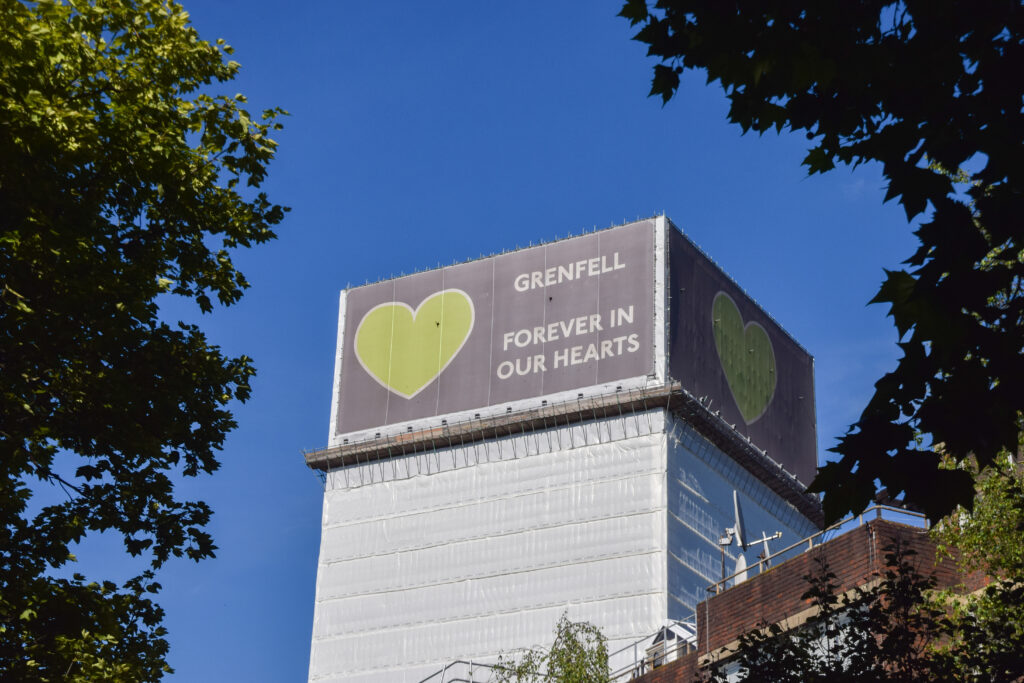
Remembering Grenfell
On 14 June, communities across the country marked the ninth anniversary of the Grenfell Tower fire, in which 72 people lost their lives. The annual silent walk took place in the evening from Notting Hill Methodist Church, led by Grenfell United, followed by the reading of the 72 names. This year carried particular weight because this was the last anniversary where any part of the tower remains standing. Dismantling of the building is underway, and for the first time bereaved families were unable to visit the site to lay flowers. MHCLG confirmed that work on the tower paused from the Friday to the Tuesday as a mark of respect. The week also saw an adjournment debate in the House of Commons on 11 June, introduced by Joe Powell MP. The Metropolitan Police confirmed that decisions on whether to bring criminal charges against up to 20 companies and 57 individuals are expected before the 10th anniversary next year. The Grenfell Tower Memorial (Expenditure) Act 2026, which passed in April, provides public funding for a permanent memorial and design team Freehaus is working with bereaved and survivor families on what that will look like. The result is expected to be announced in mid-2027. For all of us working in building safety communications, the anniversary is a reminder of why this work matters and of the community at the centre of it.
Regulatory update
The plan approval requirements consultation closed on 11 June. Below 18 metres, England’s two building control routes currently work to quite different procedural standards. Under the local authority (LA) route, most new dwellings can proceed via a building notice, meaning no plans are formally submitted or approved before work starts and compliance is checked by inspection alone. Under the registered building control approver (RBCA) route, plan approval is not mandatory at any stage: plans certificates, which confirm that submitted plans comply with the building regulations, are optional and only issued on request. The result is that many new homes are built without any design-stage regulatory scrutiny. The consultation proposed to fix this: mandatory full plans applications for all new dwellings via the LA route, and mandatory plans certificates for all new dwellings and buildings subject to the Regulatory Reform (Fire Safety) Order 2005 via the RBCA route, to be given before or with the final certificate. There is also a levy dimension: building notice applications fall outside the scope of the Building Safety Levy (in force from 1 October 2026), creating an avoidance risk that the proposals would close. MHCLG intends to bring the LA route changes in on that date, with a longer transitional period for the RBCA changes. Greater upfront scrutiny of design also creates an earlier moment at which developers and housing associations can meaningfully engage communities, before shovels go in the ground rather than after problems emerge.
The fire risk assessors profession consultation closed on 18 June. It proposes mandatory third-party certification for assessors, a new competency framework, and clearer career pathways, in direct response to Recommendation 26 of the Grenfell Inquiry Phase 2 report.
Separately, the government’s Grenfell Inquiry progress report published on 20 May confirmed that the response to the single construction regulator prospectus consultation (184 responses, closed March) is expected by June 2026, and announced a new call for evidence on building professions and duty holder accountability in higher-risk buildings.
Enforcement and decisions
BSR Gateway 2: the data continues to improve
The BSR published its Gateway 2 data for the period March to May 2026 on 9 June, and the direction of travel is clear. The Innovation Unit approval rate has risen to 90% in the 12-week rolling period to 30 May, up from 73% in the previous dataset, with a median approval time of 22 weeks. Remediation approvals have reached 79%, with median determination time falling to 39 weeks. Across all Gateway 2 categories, the overall approval rate stands at 75% and the total live caseload has fallen by more than 100 over the past month, with decisions outpacing new applications for the first time. Legacy 2024 applications have fallen to 16 remaining nationally, down from 42 at the start of 2026, and the BSR reports that 2026 approval rates now exceed the 65% target set in the remediation improvement plan. The BSR also notes that applications submitted in the fourth quarter of 2025 are moving through the system faster than earlier cohorts, suggesting that submission quality improvements are beginning to bear fruit.
For housing associations and managing agents with residents waiting on remediation decisions, these figures represent a narrative shift: the system is moving, and that is a message worth communicating proactively rather than waiting for residents to ask.
In practice
Developers and building control managers: begin reviewing your processes
For developers and building control managers, the plan approval consultation signals a tightening of procedural requirements below 18 metres. If your standard approach for new homes has relied on building notices via the local authority route, or on the flexibility of the RBCA route without a plans certificate, begin reviewing how your processes would need to adapt before regulations are laid.
Developers, social housing landlords and managing agents: earlier community engagement points
There is also a community engagement implication in the plan approval changes. Earlier formal plan approval means earlier certainty about what is being built, which is a better foundation for meaningful resident and community consultation than the current position.
The fire risk assessors consultation matters most for social housing landlords and managing agents. Mandatory third-party certification will raise the baseline across the sector, and residents have a legitimate interest in knowing that their building’s fire risk assessment has been carried out by a certified professional. Organisations that can say that clearly and that can explain what certification means in plain terms, will be better placed when residents ask questions. That means thinking now about what your communications will say once regulations are in place, and making sure your supply chain will be able to support that message.
On the BSR data, the improved Gateway 2 numbers are good news for developers with new build applications in the pipeline, but the remediation picture still shows 359 live cases nationally and a median approval time of 39 weeks. The BSR’s forthcoming guidance update on common rejection issues is worth tracking down as soon as it appears.
One to watch
The government committed to publishing its response to the single construction regulator prospectus consultation by June 2026. As of the date of this edition it has not yet appeared. When it does, it will set out the planned structure of the new body, the phasing of further reform, and the government’s position on how the construction products, building control, and professional competence regimes will be brought under a single regulatory umbrella. That matters beyond the regulatory community: one of the persistent frustrations for residents trying to understand who is responsible for the safety of their building is the fragmentation of oversight across multiple bodies. A single regulator, done well, should make it easier to give residents a clear and honest answer to that question. Watch the MHCLG publications page.
As ever, if any of this raises questions about how you communicate with stakeholders in your projects or portfolio, please do get in touch.
The Keeble Brown team
Disclaimer: This newsletter is produced for general information purposes only and does not constitute legal or business advice. Whilst we take care to ensure accuracy, the building safety regulatory landscape changes rapidly and readers should not act on the contents of this newsletter without taking specific legal or professional advice appropriate to their circumstances. Keeble Brown accepts no liability for any loss arising from reliance on the information contained herein. If you would like to discuss any of the issues raised, please contact us directly.